


Hey Everyone,
This week I am doing something different.
My son, Orlando, has started writing a substack called Orlando Doull’s Lunch Break. Orlando is 23. He works in corporate communications in Washington, DC. He’s a politics junkie.
His latest substack about Zohran Mamdani and the wave of Democratic Socialism sweeping New York, where he grew up, is thought-provoking. I know many people (my age and older) who are panicked in the way he describes, but I love how thoughtfully he argues they should not be. There is a precedent for the current moment that I think he lays out beautifully. (I think he’s omitted some important things from his argument but he tells me he has his reasons. He wanted to keep it tightly focused).
I may be his proud mom - and as you can see from the photo collage, we enjoy goofing around together - but I don’t think everything that comes out of his mouth or proverbial pen (or social media feed) is worth pondering or repeating. And he’s not shy from telling me whenever he thinks I have generated crud! But even when we disagree, we are usually able to have a constructive dialogue. Usually. There are also times where we feel frustrated with each other, like any parent and child.
As you know I am writing a book about Luigi Mangione and am therefore focused on trying to understand Gen Z, a generation that feels misunderstood and unfairly pigeon-holed by their elders.
So, when I phoned Orlando to talk about his piece on Zohran, we decided we’d try doing some mom/son live video chats around controversial topics to see if we can find a way to better understand each other’s points of view and, perhaps, bridge the generation gap between Gen X (me) and Gen Z (his).
We are noodling a title for our series, so feel free to write in with suggestions as well as ideas for subjects we should talk about
Meanwhile, his substack is below. Do subscribe to it, if you like his writing!
And, Happy July Fourth!
Democratic Socialism: The Boogeyman?
The instinct to check concentrated wealth is older than the panic about it — and it has always had a New York address.
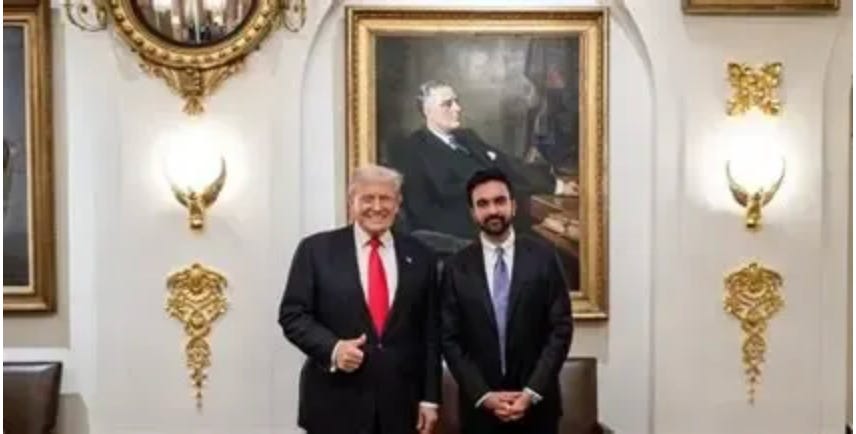
On a Tuesday night last November, my city elected a democratic socialist mayor, and a good part of the country reacted as though we’d run a red flag up over City Hall.
Zohran Mamdani took the oath on January 1st after pulling more votes than any mayoral candidate since 1969, in the highest-turnout city election since 1993. He ran on a platform that didn’t bother to be coy: freeze the rent on stabilized units, make the buses free, fund universal childcare, open city-run grocery stores, tax the top to pay for it. His opponent’s concession warned darkly about “socialism.” The President, watching from Washington, floated arresting him and choking off the city’s money. Listening to all of it, you’d be forgiven for thinking something genuinely alien had just landed in America.
It hadn’t. And the reason why has everything to do with the city that just voted.
Last week, New York held its primaries, and the message only got louder. A slate of candidates endorsed by Mamdani didn’t just win — they came for the establishment and got it. Brad Lander beat two-term Rep. Dan Goldman by nearly thirty points; Darializa Avila Chevalier knocked off five-term Rep. Adriano Espaillat, the chair of the Congressional Hispanic Caucus; and Claire Valdez took an open Brooklyn-Queens seat over the retiring incumbent’s handpicked successor. Two of the three are card-carrying members of the Democratic Socialists of America. In districts this blue, the primary is the election. Come January, Mamdani will have three new allies in Congress.
This alarmed a lot of people, plenty of them Democrats. Rep. Josh Gottheimer of New Jersey went on Fox News the next morning, called himself a “Democratic capitalist,” and announced that the socialists who’d just won were, in his telling, not Democrats at all.
I take serious issue with that, because it openly ignores history. Franklin Delano Roosevelt — arguably the architect of the modern Democratic Party, Governor of New York, four-term President — expanded the role of government in the economy about as far as it has ever gone: he created Social Security, raised taxes on the wealthy, and funded public works on a scale the country had never seen.
Gottheimer says these people aren’t Democrats. But FDR didn’t merely happen to be a Democrat who did these things. He was the modern Democratic Party — the man who built the coalition Gottheimer now claims to speak for. To call the heirs of that tradition fake Democrats is to read the party’s own founder out of it. And it was never only the Democrats. Teddy Roosevelt (FDR’s cousin) — Republican, trustbuster, face on the mountain — went after the “malefactors of great wealth” a generation earlier and used the Sherman Act to break Standard Oil apart. The instinct to put a check on concentrated money has never belonged to one party. It’s belonged to whichever one was paying attention.
And here’s what Gottheimer, of all people, should know, sitting in a seat just across the river: this instinct has a New York address. The New Deal he’s living off of was, in no small part, a New York export. Frances Perkins watched workers leap from the windows of the burning Triangle Shirtwaist Factory in 1911 and later called that day the beginning of the New Deal; she went on to become FDR’s Secretary of Labor and the architect of Social Security. Roosevelt governed here. Robert Wagner, who wrote the law that gave American workers the right to organize, was our senator. So when New York sends a slate of democratic socialists to Washington, it isn’t smuggling in something foreign. It’s doing what it has always done — exporting the argument that capitalism works best when somebody is watching it.
Notice, too, when these moments arrive. They show up when the gap between the top and everyone else has stretched near the breaking point. When the Depression hit, Herbert Hoover’s instinct was to stand back and let the market right itself. That instinct didn’t save him, and it didn’t save the country. What came after wasn’t the end of American capitalism. It was its renovation — and the renovation kept the house standing for the better part of a century.
Which brings me back to my city, and to why these candidates keep winning. This is not a fever that happened to New Yorkers. Look at what they actually said on their way out of the polls: cost of living was the top issue, ahead of crime, and three in four called the cost of housing a major problem. These are not people who read too much theory. They do the rent math every month and keep coming up short. When that’s the reality, “freeze my rent and tax the billionaires” isn’t a radical incantation. It’s an answer to a question the people in charge kept declining to answer.
Somewhere along the way we started treating “free market, hands off” as the one authentic American creed, and everything to its left as a betrayal of the founding. That’s just bad history. The tradition was never pure laissez-faire; it was a running argument over where to draw the line between a market that rewards effort and one that simply entrenches whoever already won. My own line sits about here: I am in favor of a market economy, but only when the proper restrictions on monopoly, malpractice, and misuse are in place. That is not a socialist position. Teddy Roosevelt would have recognized it. So would the New Dealers.
You could watch the modern version of that argument in Lina Khan, who ran the Federal Trade Commission until 2025 and spent her tenure dusting off the trustbusters’ tools for the age of Big Tech. The wealth gap she was reacting to isn’t subtle: the top one percent now holds about as much wealth as the entire bottom ninety percent combined — a concentration the country hadn’t seen since the Gilded Age that turned the first Roosevelt into a trustbuster. And the ground is shifting under the people who say “socialist” like it’s a spell: support for capitalism has slid to 54 percent, the lowest in Gallup’s tracking, while support for socialism has climbed to 39. A whole generation is doing the math and landing somewhere their parents didn’t, partly because the America where you could “pull yourself up by your bootstraps” doesn’t seem to exist anymore.
Which raises the question the boogeyman talk is built to avoid: what would a fair market actually take? Not its abolition. A fair market doesn’t build itself — somebody has to set the table and then keep an eye on it, and that’s the part we’ve let slide. It means breaking up the monopolies that quietly set prices for the rest of us. It means building enough housing that rent stops swallowing half a paycheck, and funding the childcare and the buses that let people show up to the economy in the first place. It means writing rules that punish malpractice instead of subsidizing it. Call that socialism if it makes you feel better. I’d call it upkeep — the maintenance a market needs to keep the one promise it is supposed to make, that effort gets you somewhere. Do that work well and you don’t bury capitalism. You give people a reason to defend it again.
None of which makes the worries imaginary. The objections have teeth: rent freezes can choke off the new housing a city desperately needs, city-run groceries can curdle into city-run boondoggles, and capital and people can leave a place that overplays its hand. Mamdani and his new allies have mandates and to-do lists, not records, and those are very different things. Skepticism is fair. Panic is not. Taking a set of fairly ordinary demands about affordability and laundering them into a red scare isn’t an argument — it’s a way of dodging one. The American economy, right now, does not work for most Americans. Plain and simple. That’s the engine under economic populism, and the lawmakers who can’t say it out loud are the ones it’ll keep running over.
So, the boogeyman. Turn the lights on in the closet and the thing standing there looks an awful lot like our own history: a country that has repeatedly decided unchecked economic power is the government’s business, and a city that has done more than its share of the deciding. New York didn’t invent that last week. It just remembered it, loudly, and in an accent Josh Gottheimer should recognize from his own side of the Hudson. The real question was never whether democratic socialism is un-American. It’s whether the people shouting the word have read past the first chapter of the story — because the rest of the book is full of exactly this fight.

Definitely appreciate any young person who appreciates history. In fact, the grasp of history here might actually be better than the grasp of the present! Might want to read up on exactly what the DSA wants. Mamdani is a generational politician, to be sure, with a great smile and personality (when you get beyond his obsessive and ugly antizionism). Here's the thing: The DSA doesn't want reformed capitalism or any form of a market economy! It wants collective ownership and a defunded police (which FDR would laugh at). How do I know? They say so, right here: https://www.dsausa.org/about-us/what-is-democratic-socialism That's not what FDR wanted and is far beyond government involvement in the economy to make life better for working people. It's something else entirely. Important to know the difference. It's a nice story to think DSA types are just continuing the legacy of FDR. The problem is: it's not exactly totally true; DSA types just want you think it is to distract you from their goals.....
😎